



















Automatic Gates
Automatic Gate Not Closing? What to Check Before You Call
Jan
Reviewed and updated: 14 October 2026
Your automatic gate is not closing. It might be sitting wide open across the driveway, or it gets halfway and stops, or it starts to close and runs straight back open. Before you ring anyone, there are a few things you can check from the ground. Begin with observation and keep clear of the entire travel area. A gate can move unexpectedly, including through a remote command or automatic-close function.
One rule first: do not push or lever the gate to make it shut. A failure to move can involve controls, power, safety equipment or a mechanical problem. The symptom alone does not establish the cause. Keep children, pets and vehicles away from the gate, and use another safe entrance while assistance is arranged if its movement is unpredictable.
Start with the safety beams
Look for two small boxes facing each other across the driveway, usually on the gate posts or on short stands low down. These are the photo cells. One sends an invisible beam to the other, and if that beam is broken the gate assumes a car or a person is in the gap. It will refuse to close, or it will start closing and reverse.
From outside the gate movement area, look for a wheelie bin, garden growth or other visible obstruction between the sensors. Only perform cleaning specifically described as owner care in the exact manual, under its stated safe conditions. Do not reach through the gate, stand between a leaf and a post or rely on someone else not pressing a remote while you work.
Many photo cells have a small indicator light that changes when the beam is blocked. If one box has been knocked by a bumper and is plainly pointing the wrong way, that’s very likely the cause. Leave the bracket and wiring alone and tell us what you found.
Automatic gate not closing all the way
A gate that moves and then stops or reverses needs its movement described accurately. It may be meeting resistance, responding to a safety device or experiencing another fault. This behaviour does not prove that a safety feature is working correctly. Do not repeatedly cycle it or change the force setting to see whether the problem goes away.
On a sliding gate, check the steel track set into the driveway. Leaves and stones collect in it, and mulch washes down from the garden beds after heavy rain. Observe the track from outside the movement area. Do not sweep behind the fence or reach near wheels, hinges or the drive mechanism. Follow the exact manual’s safe isolation and cleaning instructions, or leave the obstruction for a technician. If the track is clear and the gate still drags, the wheels may be worn, and that’s a job for sliding gate repairs.
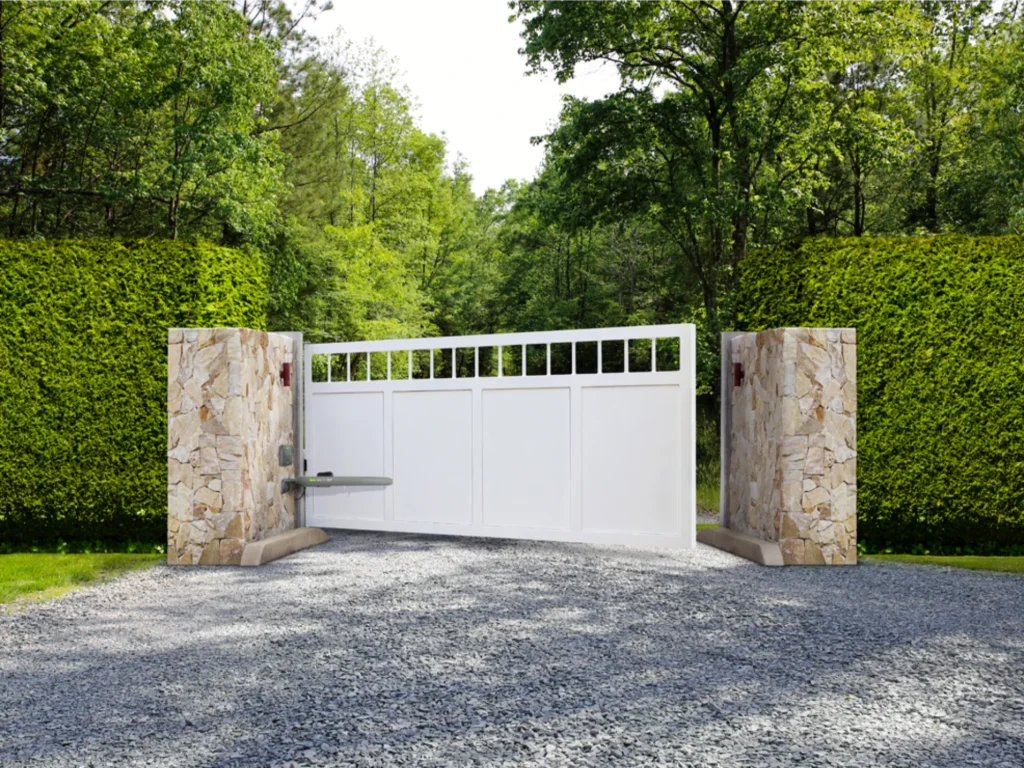
For a swing gate, observe the arc each leaf travels from outside that area. Garden growth or a lifted paver under the swinging end will stop it short. Garden beds beside the driveway are the usual trouble, and plenty of properties in Donvale and Templestowe have them right up against the gate.
From a safe position, note whether the gate or its supports look different from normal. A changed gap or leaning appearance may help an installer identify where to inspect, but it does not establish which part has moved. Do not try to realign a hinge, post or motor bracket yourself.
If nothing happens at all
If nothing responds, note whether there has been a wider power interruption and whether any normal indicator is visible. Check ordinary accessible controls only from a safe position and according to the manual. Do not enter the movement area to reach an isolator, open the control housing or reset a protective device repeatedly. Exposed wiring, water damage or a tripped protective device needs appropriate professional advice.
If the gate works from the keypad or wall button but ignores the remote, suspect the remote battery. A dim or absent indicator may be a clue, but the correct battery and remote compatibility still need checking.
Some gate systems have a manual-release arrangement. Its use and the safe method of securing the gate are specific to the installation. A released gate may roll on a slope or swing in the wind. Do not release a damaged or unstable gate, improvise a restraint or use a general article as the operating procedure. Refer to the exact Merlin manual or ask the installer for assistance with safe access.
What to leave for a technician
Some causes can’t be swept away. These are the ones we’d rather you didn’t touch:
- Grinding, juddering or other abnormal movement observed during use; do not move the gate by hand to investigate
- Force and travel settings inside the control box
- Any wiring, including the cables to the photo cells
- A leaning post or a gate that has dropped on its hinges
The force setting deserves a word. Turning it up will often get a dragging gate closing again. It also reduces the gate’s ability to stop when it meets a car or a person. The worn part is still worn, and the motor now strains against it.
Our team handles automatic gate repairs on sliding and swing gates. If the motor itself is at the end of its life, we also supply and install new automatic gate openers from the Merlin range.
If you’ve been through the checks and the gate still won’t close, call us on (03) 9812 3062. We’re family-owned and look after Melbourne’s eastern suburbs. It helps if you can tell us whether it’s a sliding or swing gate and what it does when you press the button.