







Repairs & Maintenance
How Timely Garage Door Maintenance Can Avoid Bigger Problems

Dec
Reviewed and updated: 14 October 2026
Timely garage door maintenance is less about a homeowner carrying out repairs and more about acting on changes while they are still clear to describe. A door that has always moved quietly and evenly gives a useful baseline. When that baseline changes, recording the symptom and arranging an assessment can be far more useful than trying several adjustments in the hope that the behaviour disappears.
Notice a change before it becomes routine
Pay attention to the whole routine, not one isolated noise. Does the door begin moving later than expected, sound different through part of its travel, pause, leave a gap when closed or require repeated remote presses? A single observation does not identify a part or cause, but it can help establish that the door is no longer behaving normally.
Keep visible care within safe limits
Visible care can be kept simple. Sweep loose leaves, grit and household clutter away from the doorway so they are not carried into the opening. Wipe accessible external door surfaces according to the door maker’s care guidance. These are housekeeping tasks; they are not permission to clean, lubricate, tighten or realign parts that guide or support the door.
Do not turn maintenance into adjustment
Avoid the tempting shortcuts that can change a loaded system: do not alter spring tension, cables, tracks, brackets, opener force settings, travel limits or electrical connections. Do not hold an object in a moving doorway to test a safety feature. Each arrangement differs, and owner testing that is not described in the exact manual can create a new fault or put someone in the path of a door.
Know the stop-use signals
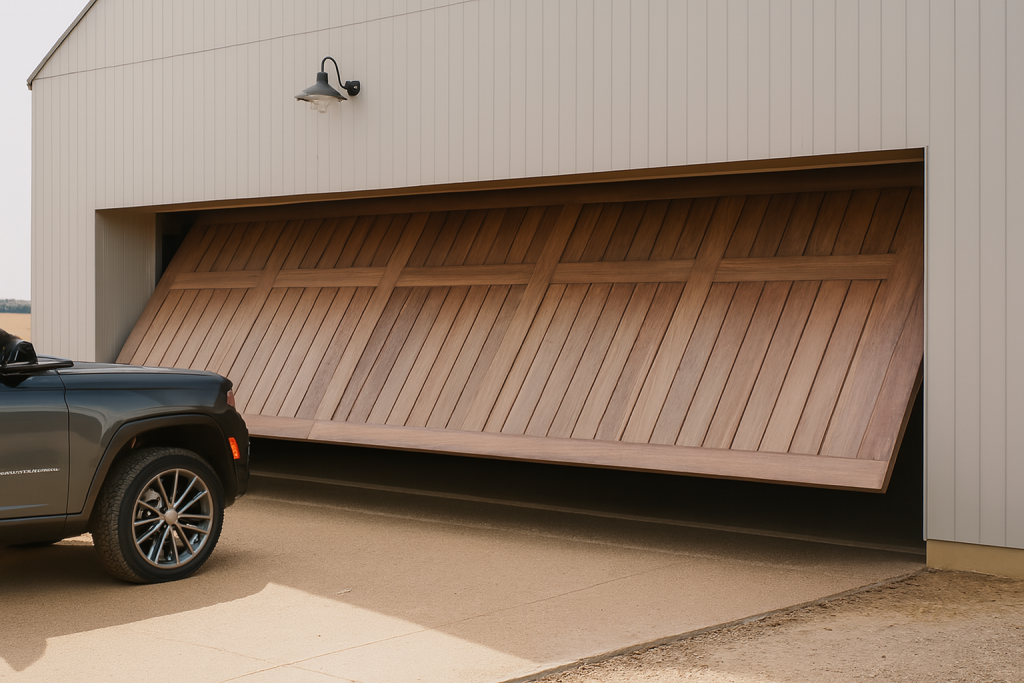
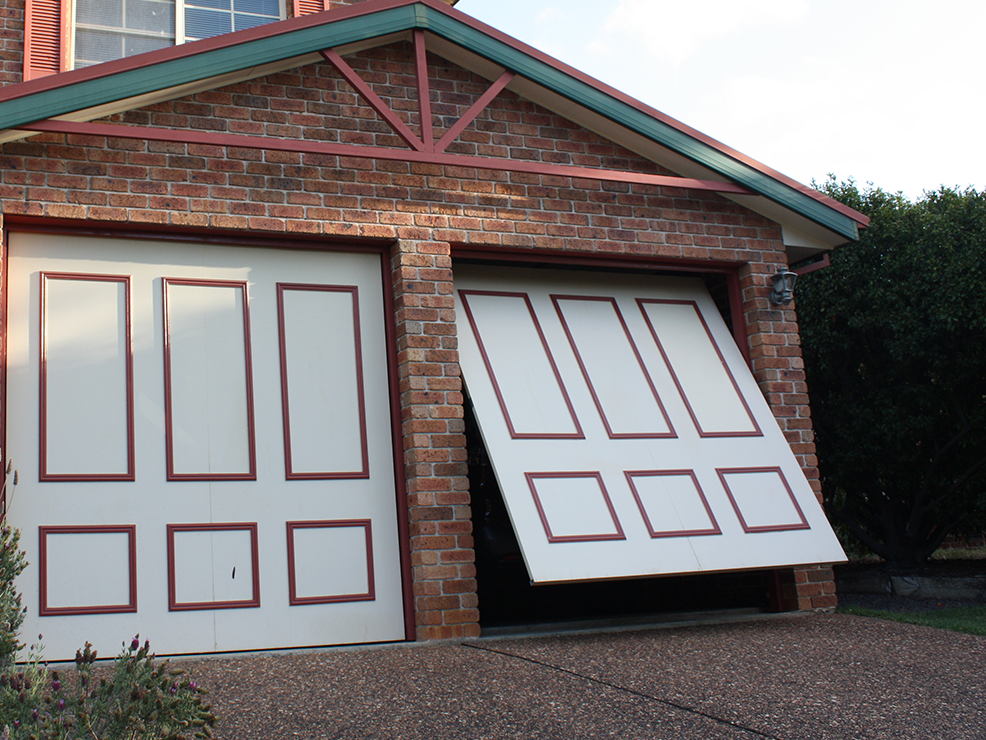
Some observations should end normal use until the door is assessed. Examples include a door that sits unevenly, a cable that appears loose, an obvious dent after vehicle contact, a door that is off its normal path, heavy operation, a sudden loud bang, or movement that is jerky or unpredictable. Keep people and vehicles clear of the opening rather than attempting a final cycle to see whether it improves.
Prepare a useful service enquiry
An early service enquiry is most helpful when it describes what changed and when. Note whether the fault occurs during opening, closing or both; whether the door is fully closed now; whether an impact or power outage occurred nearby; and whether there is visible damage. If an opener is fitted, the model number can be useful if it can be read without climbing, reaching over the door or moving equipment.
Maintenance also includes the environment around the door. Store ladders, sporting equipment, bins and tools where they cannot be left under the door or against its edges. Keep children from treating the remote or wall control as a toy. These habits reduce accidental activation and give an operator a clear view of the doorway before the door is moved.
Do not assume that a door must be operating in order to seek advice. A stable closed door with an unfamiliar symptom can be left closed while a service visit is arranged. This can be the more practical option when the alternative would be manual lifting, an improvised release or another attempt to force a jammed door.
Eastern Garage Doors lists slow or jerky movement, grinding or loud noise, uneven or off-track position, unresponsive controls and a heavy door as signs to stop operating the door and contact the team. That gives homeowners a clear threshold: describe what can be seen and heard, then leave diagnosis and repair work to the assessment.
The benefit of timely attention is clarity. It preserves the original symptom, avoids compounding a fault with unverified adjustments and lets a technician inspect the actual door, opener and site conditions. It does not require a promise about costs, repair time or the remaining life of the door; those depend on the condition found on site.
A useful maintenance record can be ordinary: the date a change was first noticed, a note that the sound occurs near the end of closing, or a photograph of obvious exterior damage taken from a safe distance. It should not become a checklist that encourages dismantling. Keeping the observation separate from a technical diagnosis means a later assessment starts with evidence rather than a guessed repair history.
Weather and household activity often change what ends up near a garage. After gardening, moving furniture or clearing storage, check only that the opening and threshold are free of loose objects before the door is used. Do not use a broom, hose or tool around the moving mechanism while the door is active. If debris is caught in a place that cannot be safely reached with the door at rest, leave it for the service discussion.
There is a practical difference between routine care and maintenance work. Routine care preserves a clear, usable area and helps a household notice changes. Maintenance work may involve parts that support, guide or control the door. Treating those as the same job is where well-intentioned home fixes can become unsafe. The sensible owner action is to describe the change early and retain the normal condition for inspection.
Sources and support
Eastern Garage Doors Garage Door Servicing and Repairs and Eastern Garage Doors Contact Us.
For a garage-door fault or servicing enquiry, contact Eastern Garage Doors with the visible symptoms and the door’s current position.