






Repairs & Maintenance
When to Book a Garage Door Check-Up

Oct
Reviewed and updated: 14 October 2026
A garage-door check-up is most useful when it is prompted by information about the door in front of you, rather than an arbitrary date on a calendar. Different doors, openers, finishes and households have different histories. The important question is whether the system is operating as expected and whether something in its condition, surroundings or use has changed.
Follow the documented service requirements for the fitted door and opener, including any applicable warranty conditions. The changes below are additional reasons to seek advice between planned visits. Booking an assessment does not mean a major repair will follow. It gives a trained person an opportunity to understand the installation, record what is found and explain any recommended work. The following triggers are practical reasons to arrange that conversation without promising a universal timetable or a particular outcome.
Its movement has changed
Take notice when a door becomes noticeably slower, noisier, uneven or reluctant to open or close. A new pause, scrape, shudder or reversal is worth recording, even if the door later completes a cycle. Note the point at which it occurs and whether it followed a power interruption, impact or unusual weather. A short observation is more helpful than a guess about which component caused it.
Do not repeatedly operate the door to investigate a new behaviour. If movement is clearly abnormal, keep people, vehicles and stored items clear and ask for advice. Avoid manual-release tests, balance tests or adjustments to springs, cables, tracks and opener settings. Those parts require an assessment appropriate to the installed system.
There has been an impact or visible damage
Vehicle contact, storm debris, a dented panel, bent material or a damaged seal are reasons to arrange a check, even where the door still appears to work. Damage can be cosmetic, but it can also affect clearances or movement. Take photos from a safe distance, note when it happened and avoid putting pressure on the damaged area.
Look around the opening as well as at the door. New cracks, water entry, loose trim, changed paving or a newly installed storage unit can alter how the garage is used. Mention these details when booking. A check-up is stronger when it considers the door and the space in which it operates.
The garage is being used differently
Changes to a household can be a sensible prompt for a check-up. A new driver, different vehicle, new pet, home workshop, renovation or a garage that has become the main entrance all change the way people interact with the door. This does not mean an existing door is automatically unsuitable. It means the new use should be explained so the system can be assessed in context.
Bring up access needs too. Several remotes, shared users or phone-based controls can make it important to keep an accurate record of authorised devices. Ask for current model-specific information before assuming a Merlin accessory or smart feature is available for the existing opener. Compatibility depends on the equipment rather than a broad product category.
The controls are behaving differently
A remote, wall control or keypad issue may be a simple access-device problem, but it still deserves a clear description. Record which control is affected, whether another authorised control works and whether the issue began after a battery change, lost remote or power interruption. Keep the opener model information where it can be found.
Do not erase remotes or reset programming in an attempt to fix an unexplained fault. That can remove access for other users and leave the original cause unresolved. If a device is lost, treat it as an access matter and ask what response is appropriate for the exact system. Never share app passwords, access codes or verification codes with an unknown caller.
There is a safety concern
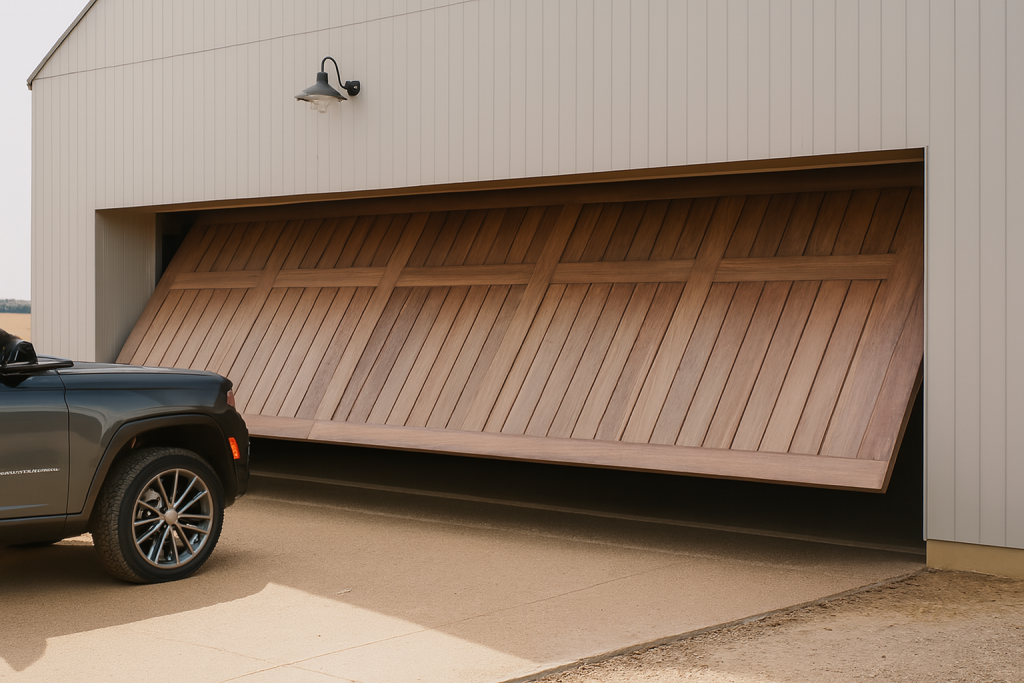
Book urgent advice if the door is partly open, has visible damage, moves unevenly, drops, stops unexpectedly or does not respond normally. Keep the area clear and tell the provider where the door has stopped. Do not work beneath a stopped door or use props, ropes or makeshift supports to hold it in place.
Children and pets add another reason to review the garage routine. Keep toys, bikes and bins out of the door’s path, and ensure drivers can observe the driveway before moving a vehicle. Equipment features may support safe use where fitted, but they do not replace careful observation around a moving door and car.
Records are incomplete or the property has changed hands
When buying a property, renovating or taking responsibility for a garage after a tenancy, gather the records that are available. Identify the door type, opener model, known repairs and existing controls. A recent-looking remote or motor does not establish the condition of every other part of the system. An assessment can start from the actual installation instead of assumptions about its age.
Keep future records concise: date, symptom, work undertaken, parts identified and any operating advice. That history helps a later technician separate a long-standing mark from a new fault. It also helps a household avoid repeating unsuited fixes that do not address what was originally observed.
Prepare for a useful assessment
Before the appointment, clear vehicles and storage from the operating area where possible. Have the opener label, remote details and relevant manuals available. Explain whether the door is currently open, closed or partly open, and do not alter it merely to make the visit easier. Safety comes before convenience.
Eastern Garage Doors can discuss current symptoms, condition and sensible next steps for your garage-door system. Use the contact page to provide the door type, known equipment details and the change you have noticed.