



















New Garage Doors
What Happens on the Day of Your Garage Door Installation
Aug
Reviewed and updated: 14 October 2026
You have chosen a garage door and are preparing for installation. The practical questions are usually about access, clearing the work area and understanding the finished system. This guide sets out what to discuss with Eastern Garage Doors before the day; the written scope and arrangements for your particular property take priority over a general description.
What needs sorting before installation day
Confirm that the opening has been measured and the proposed door and installation requirements agreed before manufacture or installation. We look at the headroom above the opening and the clear space running back along the ceiling, because those decide which door and opener will fit. If you’re still choosing, our page on new garage door installations covers the door types we fit.
Your part is making room for us to work.
- Move the cars out, and park on the street if the driveway is short.
- Ask the installer how much work space is needed, then move loose stored items from that agreed area.
- Identify overhead bikes, racks or other obstacles before the visit. Agree who will remove them safely; do not dismantle fixed items or work near door hardware yourself.
- Check there’s a power point near where the opener will sit.
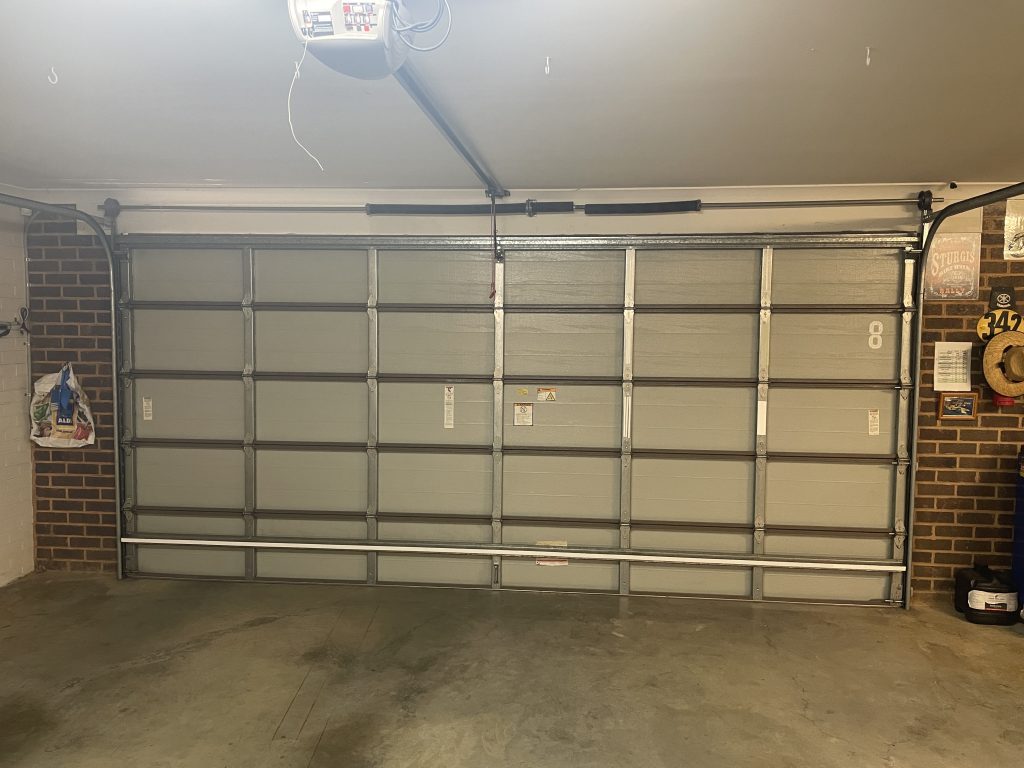
That last one catches people out. Many sectional and tilt installations use an overhead rail arrangement, while other opener configurations are available. The proposed model determines the installation space and power requirements. A roller door opener sits at one end of the roll, up beside the opening. If your garage in Lilydale or Mooroolbark was built for a manual door, there may be no power point anywhere near either spot. Tell us before the day, because adding one is an electrician’s job.
How the garage door installation runs on the day
For a replacement project, ask whether the quote includes removing the old door, its hardware and waste. A new opening may have a different scope. The installer should explain the work area and access arrangements before beginning. Keep household members and vehicles away from the installation area throughout the work, including when the door appears stationary.
The support structure, fixings, tracks and brackets need to suit the proposed door. Their condition and alignment are installation matters for the technician. A sloping floor, altered opening or uncertain fixing surface may affect the work required. Ask how any unexpected condition will be explained and priced before extra work proceeds, and who is responsible if another trade needs to attend.
The way the door is assembled and fitted depends on its type and the manufacturer’s instructions. A roller curtain and sectional panels are handled differently. Homeowners do not need to help lift panels or hold parts in place. Agree on a safe place to remain and use another entrance while the installation is underway.
Springs are set by the technician, and it’s the one part of the day we’d ask you to stand well back from. Springs store energy and form part of the door’s counterbalance system. They may remain hazardous even when the door is closed. Setting or adjusting it is never a homeowner job, on the day or years later.
The installer needs to assess the door’s mechanical operation before commissioning its opener. Ask for confirmation that the complete door and motor combination has been checked. Do not copy a balancing test yourself or use the opener to overcome stiffness. An apparently successful opening cycle alone does not establish that every part of the installation has been checked.
Commissioning follows the instructions for the actual opener, controls and safety equipment. Ask the installer to explain which checks were completed and demonstrate normal operation at handover. Travel limits, force settings and safety-device tests are not settings to experiment with later if the door develops a fault. Record the model details so future advice can refer to the installed system.
Timing depends on the opening, removal work, installation and any other trades involved. Ask for the expected arrangements for your job, including when vehicle access is needed and what happens if an unforeseen condition is found. Do not assume a same-day completion or a particular arrival window unless it has been confirmed for the booking.
What we show you at handover
Arrange a handover with the installer and make sure the regular users can understand the basic controls. If someone cannot be there, ask which written instructions they should read before using the door. Confirm any job-specific follow-up arrangements instead of assuming that a particular visit or service is automatically included.
Ask the installer to demonstrate the correct manual-release and re-engagement procedure for the exact door and opener, and show you where it is documented. Do not release an open, partly open, damaged or unstable door on the basis of a generic instruction. The handover should explain when manual operation is appropriate and when to keep clear and call for help.
If your opener has a wall control, that’s the button mounted inside the garage, usually near the door into the house. It opens and closes the door without a remote.
Ask what normal movement and sound should be for the installed system. If you later notice scraping, a new bang, uneven movement or unexpected reversal, stop using the door and seek advice. A new installation should still be judged by its actual behaviour; do not dismiss a change merely because the equipment was recently fitted.
Warranty and the first service
Ask for the warranty documents covering the actual door, opener, installation and accessories. These can have different periods, conditions and claim processes. Merlin provides model-specific information through its Australian support page. A written warranty is additional to rights under Australian Consumer Law, which may continue after the stated warranty period. Do not treat a general range in an old article as the warranty applying to your purchase.
Keep the maintenance schedule supplied for the door and opener, and clarify which tasks belong to the owner and which require a technician. Ask when the first service is recommended for the actual installation and what it includes. Retain the invoice, model details and any service records together so a later enquiry can be checked against the correct equipment and purchase.
If you have questions before your install, call us on (03) 9812 3062 or send us an enquiry. We’re a family-owned business and we look after Melbourne’s eastern suburbs.