



















Repairs & Maintenance
Why Won’t My Garage Door Close? What to Check First
Nov
Reviewed and updated: 14 October 2026
You press the button, the door heads down, then it stops and goes back up. Or it doesn’t move at all and the opener light blinks at you. When a garage door won’t close, the cause may involve an obstruction, controls, safety equipment or the door itself. Start with safe observations, and stop if the door is damaged or moving unpredictably.
Work through it in the order below.
Start with the safety beams
If your installation has Safety IR Beams, identify them using the manual for the installed equipment. Their mounting and indicators are model-specific. One sends an invisible beam across the doorway and the other receives it. If anything breaks that beam while the door is closing, the opener stops and reverses.
A loose item or visible obstruction may be relevant. Look from a safe position before touching anything. Remove ordinary loose clutter only when the door is stationary and you can remain outside its travel area. Do not work beneath a raised door or reach into the mechanism to clear a suspected obstruction. If safe access is uncertain, leave it for the technician.
From outside the moving-door area, note any visible obstruction or a sensor that appears damaged or displaced. Indicator meanings depend on the model, so compare what you see with the correct manual. Do not bend a bracket, move a sensor, alter wiring or bypass a safety device to make the door close. A displaced unit needs the right assessment and verification of the safety system, not an improvised alignment.
If an indicator remains abnormal, record its colour and whether it is steady or flashing. Report visibly damaged wiring without touching or tracing it around the moving mechanism. Keep people clear and ask for assistance if the system will not operate safely.
Why a garage door won’t close at certain times of day
Record whether the fault happens at a particular time of day or in particular lighting conditions. Sunlight may be one factor for an installer to investigate on some sensor arrangements, alongside alignment, obstruction and other causes. Neither the direction the garage faces nor its suburb proves the diagnosis. A brief record of the timing gives the technician something specific to compare with the installed equipment.
Note the time and lighting conditions when the fault occurs and pass that information to the technician. Do not hold a hand or cardboard near a sensor while operating the door, fit a homemade shield or swap components yourself. The installer can assess sunlight and other possible causes using the correct equipment instructions, then confirm safe operation.
Check the wall control and the power
Many wall controls have a lock or holiday mode that stops the remotes from working. It’s easy to switch on by accident with a long press. If the remotes do nothing but the wall button still runs the door, look there first, and check the opener’s manual for how to turn it off.
If nothing responds, note whether other equipment has also lost power. Look at the opener’s power connection only from a safe position. Check a plug or switch only if it is normally accessible without climbing or reaching near door hardware. Do not remove electrical covers, handle damaged wiring or repeatedly reset a tripped safety switch; seek appropriate professional advice.
We’ve put a few more basic checks on our troubleshooting page.
When the door itself is the problem
An opener measures how hard it has to work. If the door gets heavier or stiffer than it was when the opener was set up, the opener decides it has hit something and reverses, even with a clear doorway and healthy beams.
Wear, damage or changes around the opening can affect movement. Tell the technician about a scrape, clunk, vehicle impact or altered travel, including when it first appeared. Different door systems can produce similar symptoms, so a sound at a particular point does not prove a spring, roller or track diagnosis. Avoid moving the door repeatedly to demonstrate the problem if it is behaving abnormally.
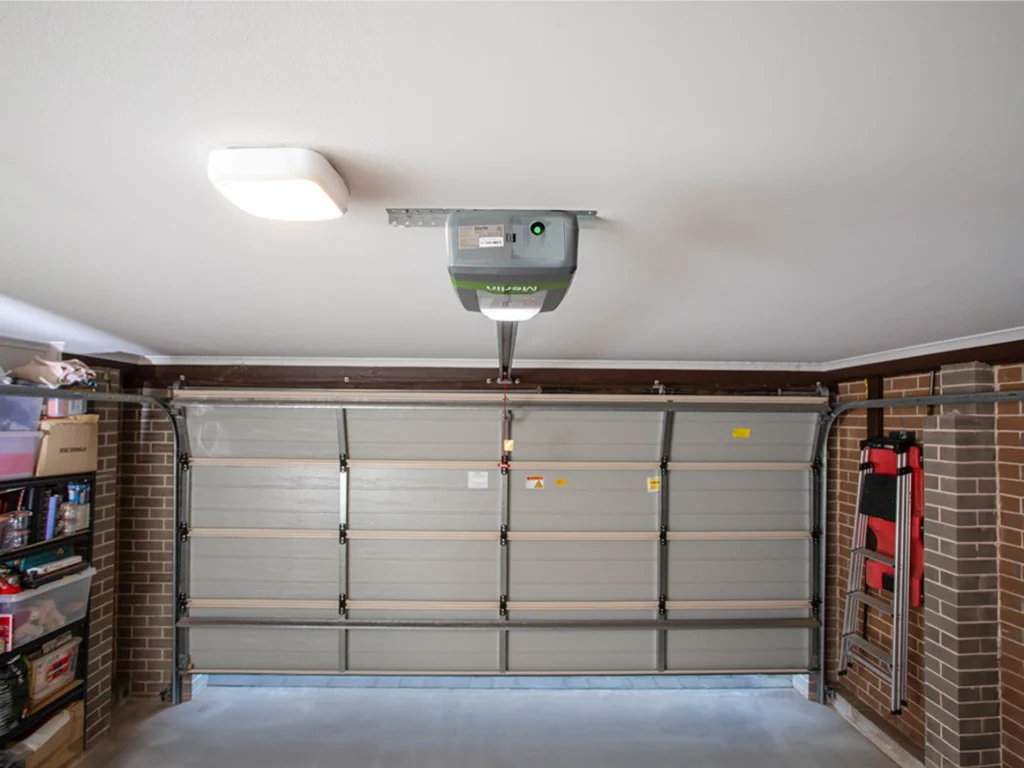
A technician may need to assess the door, travel limits and operating force together. Do not change those settings to compensate for unexplained resistance. If yours is a Merlin, our team also handles Merlin opener repairs. Turning the force up to get past a stiff spot is the wrong fix, though. It hides the fault and weakens the safety reverse. The door needs to be sorted out first.
Stop pressing the button and call someone if you see any of these.
- The door reverses again and again with the opening clear and both beam lights steady
- The door hangs crooked, with one side lower than the other
- A lifting cable looks frayed or has gone slack
- A spring has a visible gap in its coils
Springs and cables carry the full weight of the door and sit under heavy tension, so adjusting or replacing them is a technician’s job. Leave the door where it is and don’t try to lift it or force it down.
If you’ve been through the list and the door still won’t stay shut, ring us on (03) 9812 3062. Our team handles garage door servicing and repairs, and we look after Melbourne’s eastern suburbs.