






Safety & Security
Merlin Garage Door Locks: Compatibility and Security Considerations

Oct
Reviewed and updated: 14 October 2026
A garage-door lock or access device is part of a wider system: the door, the opener, the physical opening and the people who are allowed to use it. It is not a universal upgrade that can be chosen from a product name alone. Merlin’s current product information shows that compatibility is specific to the motor and accessory. The safest starting point is to identify the installed opener, decide what access issue needs to be solved and seek confirmation before any lock or release hardware is selected or fitted.
Define the security concern first
Do not assume that a lock alone answers every concern. The condition of the door matters as much as the access device. A door that is damaged, uneven, noisy, difficult to close or not sitting normally needs a professional assessment before an owner treats the issue as a lock problem. A closed door is not made secure merely by a label or an app setting, and no article can guarantee that a particular arrangement prevents every form of entry.
Identify the Merlin opener accurately
Merlin advises that the motor model number can usually be found on the motor unit, with the position varying according to installation. Make a note from a safe standing position. If the label cannot be seen without climbing, removing a cover or getting near moving equipment, do not try to reach it. Merlin’s homeowner support page has product documentation and a compatibility tool that can help turn the model number into a more precise support enquiry.
Also record the door type if known, the current controls in use and whether there is another normal entrance to the garage. These details affect the question a dealer or technician needs to answer. A remote or keypad that looks similar to another product does not establish compatibility. Neither does a reference to a feature on a newer model. Model-specific advice is especially important before purchasing a device, changing access arrangements or planning an emergency-access option.
Understand automatic locking and physical locks
Merlin refers to auto-lock technology in its current material for automatic garage-door openers. That is a product characteristic to confirm for the actual installed system, rather than a reason to assume that every door has the same physical locking arrangement. An automatic opener, a manual lock and a keyed release serve different purposes and can interact with a particular door in different ways. The right choice depends on the complete installation and how the garage is used.
Do not add, remove, repair or adjust a lock, latch, release cable, bracket or wiring as a homeowner project. Avoid drilling, fitting or altering hardware near a moving door. Do not override a manual release arrangement or assume that a physical lock is appropriate for an automated door. These decisions can affect operation and safe access. A professional can confirm what the door and opener are designed to accommodate.
Separate emergency access from everyday security
A keyed manual release is designed to provide access where an automated system is unavailable and there is no second entry point. Merlin’s CM1702 Keyed Cable Release product page lists specific compatible Merlin garage-opener models and presents a compatibility check. This is a good example of why exact model confirmation matters. A release arrangement is not an invitation to operate an unfamiliar or abnormal door, and it should not be selected or installed from a generic online guide.
If a power interruption, missing remote or other access issue arises, use the manual for the fitted model or contact Merlin support or a suitable dealer. Do not force, lift, pull, reconnect or attempt to disengage a door that is open, damaged, heavy, unstable or not closing normally. Springs, cables, electrical components and door force are professional matters. If access is urgent, state the door’s present position and the reason access is needed when asking for help; another entrance or temporary arrangement may be the safer immediate option.
Manage household access deliberately
Good security also comes from ordinary habits. Keep remotes in controlled locations and out of unattended vehicles. Decide who genuinely needs a remote, keypad credential or connected-app access. When somebody no longer needs access, remove it through the model-specific process or ask for assistance. Keep a simple record of the opener model, the accessories in use and the support contact path. It is far easier to deal with a lost device or changed household arrangement when these details are available.
When using any control, remain able to see the full opening and wait for normal movement to finish. A notification or confirmation sound is not a substitute for supervision of the doorway. Children should not play with remotes or wall controls, and nobody should pass beneath a moving door. These habits protect people as well as the access arrangement, and they apply regardless of whether a particular lock or connected feature is fitted.
Know when security has become a safety issue
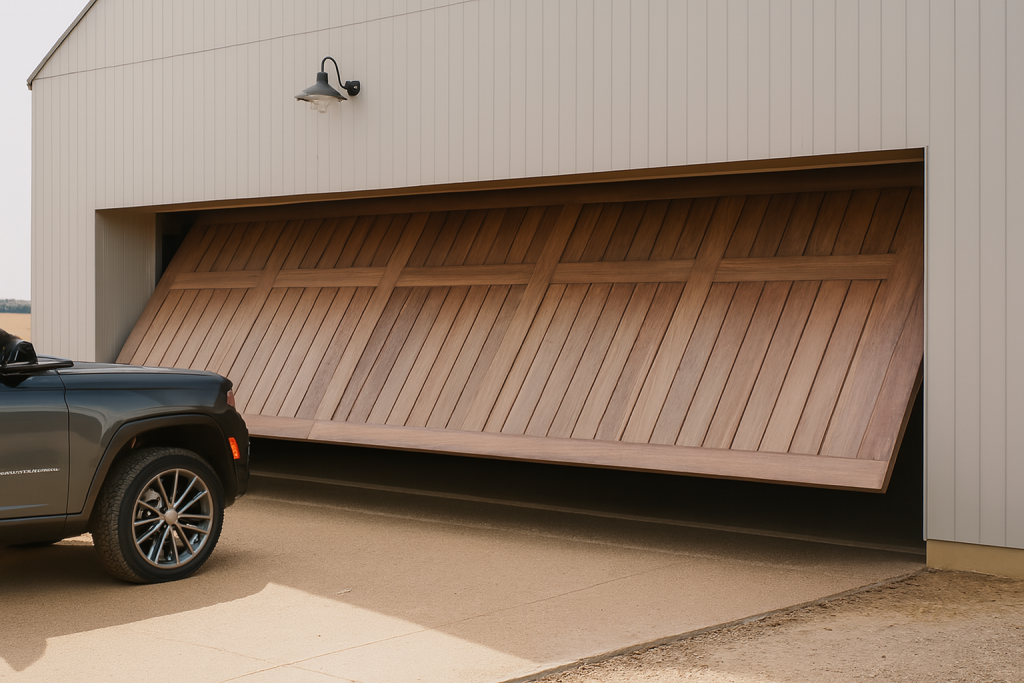
Stop using the door and arrange professional help if it is visibly damaged, moves unevenly, is noisy in a new way, appears off its normal path, cannot close normally or responds unpredictably. Do not repeatedly operate the controls to test it, and do not handle cables, springs, tracks or the opener. Keep people, vehicles and stored items clear of the opening. An open or unstable door should be treated as an exclusion area until it has been assessed.
Eastern Garage Doors can assess service and repair needs on site. Give the door’s current position, visible symptoms, opener model if known and the access concern you are trying to address. A professional can then separate a mechanical fault from a compatibility question and recommend an approach based on the real installation.
Sources and support
See the Merlin CM1702 Keyed Cable Release compatibility information, Merlin homeowner support and Eastern Garage Doors servicing and repairs.
For a lock, access or door-condition concern, contact Eastern Garage Doors with the known model details and the door’s current position.